One of the most important factors in Bible interpretation—if not the most important—is honesty. We Bible interpreters often struggle to remain honest when Scripture contradicts our well-entrenched beliefs. Yet we are interpreting a book that repeatedly warns against dishonesty. Our Bibles tell us that all liars will be cast into a lake of fire!
In this final teaching about modern Israel, I will do my best to interpret Romans 11—oddly a favorite of dispensationalists—honestly. That requires reading the chapter in context with the rest of Scripture. The Bible can be made to say almost anything by isolating verses and passages.
For example, someone who is ignorant or dishonest could conclude from Romans 11 that God opened the door of salvation to Gentiles only because the Jews rejected Jesus. Had they not rejected Him, the door would have remained eternally closed to Gentiles. Moreover, God supposedly opened that door purely to make Jews jealous so they might open their hearts to Jesus. All of that can—and sometimes is—extracted from Romans 11.
That kind of view portrays God as a racist, as if He favors one special group above all others. Those of us who have read the rest of the Bible know He is not a racist. We have already seen in this series that God’s very first communication to Abram/Abraham did not promise him or his descendants land. Instead, God told him that in him all the families of the earth would be blessed (Gen. 12:3). God was already thinking about forgiving and saving people from “every tribe and tongue and people and nation” (Rev. 5:9) through Abraham’s special descendant, the Lord Jesus Christ.
John did not write, “God so loved the descendants of Jacob/Israel.” He wrote, “God so loved the world, that He gave His only begotten Son” (John 3:16). You would not know that if you listened only to some dispensationalists. To them, everything revolves around Israel. Worse, they often conflate the physical descendants of Jacob/Israel with a modern geopolitical nation (consisting mainly of descendants of Judah, Benjamin, and Levi) and its current political policies.
When Paul lists in Romans the advantages that descendants of Jacob/Israel have over Gentiles, he never includes “salvation.” In fact, one reason he wrote Romans was to counter the idea—held by many Jews—that uncircumcised, law-breaking Gentiles could not be saved.
Neither does Paul ever list “land possession” as an advantage. He knew that God gave land not only to the ancient descendants of Jacob/Israel but also to certain Gentile groups. God told the second generation of Israelites after the Exodus:
“You will pass through the territory of your brothers the sons of Esau [brother of Jacob] who live in Seir; and they will be afraid of you. So be very careful; do not provoke them, for I will not give you any of their land, even as little as a footstep because I have given Mount Seir to Esau as a possession”…. Then the Lord said to me, “Do not harass Moab [Jacob’s first cousin once removed], nor provoke them to war, for I will not give you any of their land as a possession, because I have given Ar to the sons of Lot as a possession…. When you come opposite the sons of Ammon [Jacob’s first cousin once removed], do not harass them nor provoke them, for I will not give you any of the land of the sons of Ammon as a possession, because I have given it to the sons of Lot as a possession” (Deut 2:3-5, 9, 19; see also Josh. 24:4; Amos 9:7).
Moreover, as we have seen in previous lessons, Abraham himself is still waiting to inherit the Promised Land—and so am I, one of his descendants through my Lord Jesus Christ. One day we will all live in New Jerusalem. Note that it will not be “New Chicago,” “New London,” or “New Nairobi!”
An Honest Look at Romans 11
When dispensationalists try to prove from Romans 11 that modern descendants of Jacob/Israel have a divine right to modern Palestine by virtue of God’s covenant with Abraham, they must add what simply is not found in the chapter.
Paul begins by declaring that God has not rejected the descendants of Jacob/Israel:
I say then, God has not rejected His people, has He? May it never be! For I too am an Israelite, a descendant of Abraham, of the tribe of Benjamin. God has not rejected His people whom He foreknew (Rom. 11:1-2a).
That verse-and-a-half ends any notion of “Replacement Theology.” God’s salvation plan includes Jews—but only those who believe.
Paul offers himself as proof that God has not rejected “His people.” The proof is clearly Paul’s salvation, not land ownership. Everything in Romans 11 concerns salvation. Nothing concerns land. And everything concerns the people of Israel—the physical descendants of Jacob/Israel—not the modern geopolitical nation of Israel or the policies of its current administration.
Paul then explains that God has hardened those among the Jews whom He has not chosen. They are not unconditionally chosen, as some claim, but conditionally chosen, as the New Testament repeatedly affirms. God saves those who believe in the Lord Jesus Christ. They are the ones He has chosen; therefore they are His chosen ones.
God has not hardened unbelieving Jews against their wills, but in coincidence with their wills. It is an act of His righteous judgment. Yet that hardening is temporary. Near the end of the chapter Paul writes that “a partial hardening has happened to Israel until the fullness of the Gentiles has come in; and so all Israel will be saved” (11:25-26a). As we have discussed in previous articles, when Jesus returns there will be a great awakening among Jews when they look on Him “whom they have pierced” (Zech. 12:10).
The Two Olive Trees
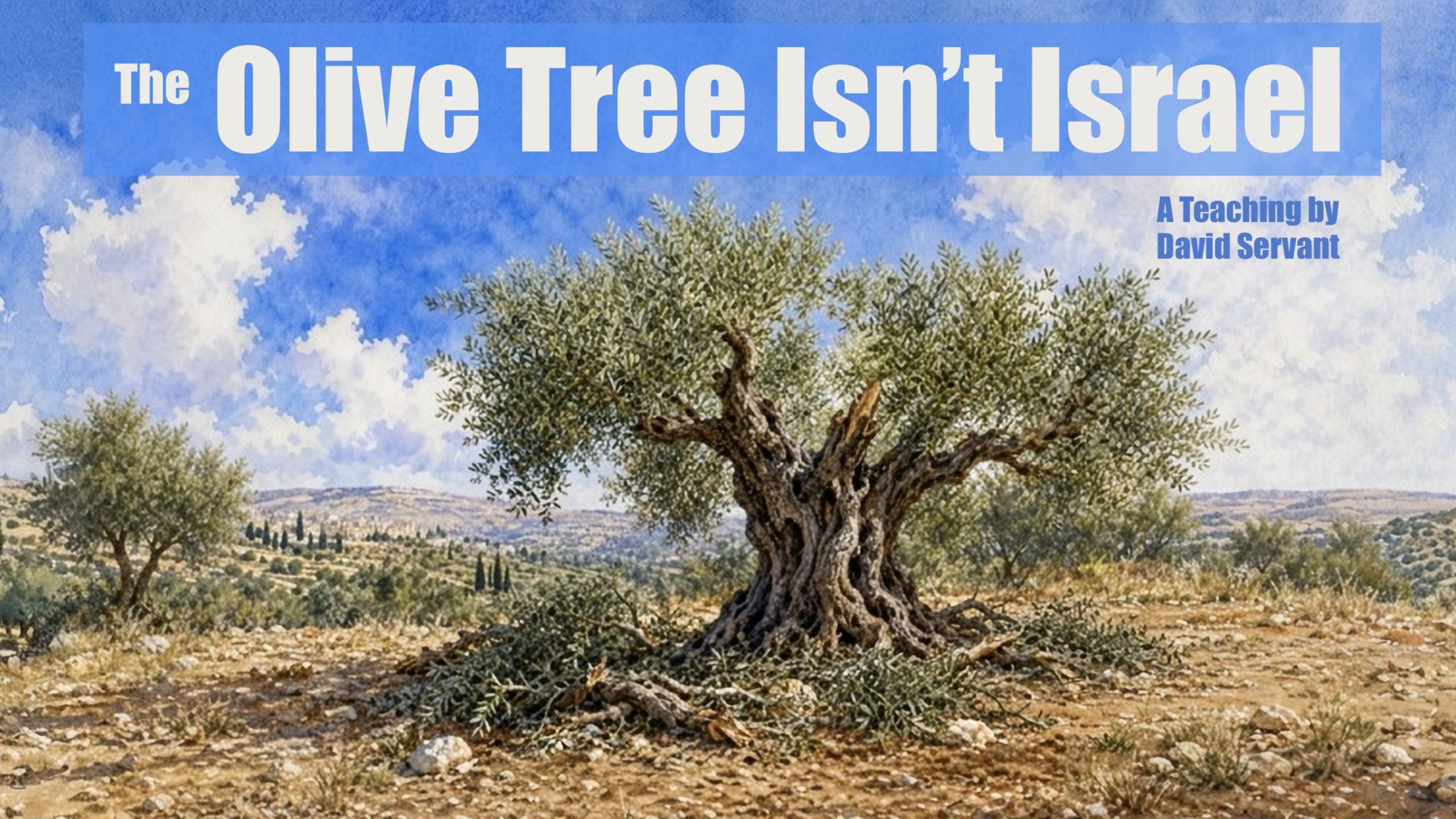
Within Romans 11, Paul employs an analogy of two olive trees—an image very appropriate for his readers in Rome. Olive cultivation in Italy dates back to at least the 8th–6th centuries BC and remains a cornerstone of Italian culture today.
Before we examine the text, keep in mind that all analogies are imperfect. The two things compared are never identical in every way. Analogies highlight certain similarities for illustration, but they always break down at some point. For example, if I tell my wife her eyes are like pools, I mean they are blue, deep, and inviting. I do not mean that fish swim in them or that ducks land on them. We must therefore be cautious not to assign significance to an analogy that the author never intended. With that caution in mind, let’s read Paul’s olive-tree analogy:
If the first piece of dough is holy, the lump is also; and if the root is holy, the branches are too. But if some of the branches were broken off, and you, being a wild olive, were grafted in among them and became partaker with them of the rich root of the olive tree, do not be arrogant toward the branches; but if you are arrogant, remember that it is not you who supports the root, but the root supports you. You will say then, “Branches were broken off so that I might be grafted in.” Quite right, they were broken off for their unbelief, but you stand by your faith. Do not be conceited, but fear; for if God did not spare the natural branches, He will not spare you, either. Behold then the kindness and severity of God; to those who fell, severity, but to you, God’s kindness, if you continue in His kindness; otherwise you also will be cut off. And they also, if they do not continue in their unbelief, will be grafted in, for God is able to graft them in again. For if you were cut off from what is by nature a wild olive tree, and were grafted contrary to nature into a cultivated olive tree, how much more will these who are the natural branches be grafted into their own olive tree? (Rom. 11:16-24).
In this analogy Paul identifies one olive tree as wild and the other as cultivated. A cultivated tree requires a cultivator—the one who prunes it so that it bears the highest quality and quantity of fruit.
Paul mentions that pruning. Some branches have been broken off (the Greek can also be translated “cut off,” as in 11:24 in the NASB) from the cultivated tree, and wild olive branches have been grafted in their place. This is standard practice in olive cultivation: unproductive, dead, diseased, overcrowded, or shaded branches are removed, and high-yielding cuttings are grafted in.
Paul’s contemporary readers would have understood that the cultivator is God (just as in Jesus’ Parable of the Vine and the Vinedresser) and that the olives represent the fruit God desires—holiness. Paul highlights this holiness at the outset: “If the root is holy, the branches are too” (11:16). We can therefore call the cultivated olive tree the “tree of holiness.” The tree and its branches are nourished by holy roots, so everything growing from those roots should be holy. The grafted-in branches are “partaker(s) … of the rich root of the olive tree” (11:17). They are alive, in contrast to the dead branches that have been cut off.
What connects the branches to the tree is faith. Natural branches were cut off because of unbelief; wild branches were grafted in because of faith. If the broken-off natural branches believe, they will be grafted back in. If the grafted-in wild branches stop believing, they will be cut off (11:17-24). It is all about faith.
We could also call the cultivated olive tree the “tree of faith.” True holiness always springs from heart faith. Paul affirms this at both the beginning and end of Romans when he speaks of “the obedience of faith” (Rom. 1:5; 16:26).
Combining these truths, it is accurate to refer to the cultivated olive tree as “the tree of faith and holiness.”
To claim that this cultivated olive tree represents the geopolitical nation of Israel—whether ancient or modern—is simply dishonest. Nothing in the analogy or its context even hints at such an idea. It would be like claiming that every ancient descendant of Jacob/Israel walked with God, or that every modern descendant believes in the Lord Jesus Christ. Furthermore, if Paul’s olive tree represented the geopolitical nation of Israel, what would the broken-off branches represent? (I am waiting for some dispensationalist to claim they represent Arab nations or Christians who do not enthusiastically support every political decision of modern Israel’s current administration.)
Clearly, the “broken-off branches” represent unbelieving and unholy descendants of Jacob/Israel. They are not part of the living olive tree. They are dead branches, destined to be burned.
To admit that the cultivated olive tree does not represent a geopolitical nation, yet still claim it represents all physical descendants of Jacob/Israel, is equally wrong for the same reasons.
Moreover, heart faith and the holiness that flows from it predate Jacob/Israel. They go all the way back to Abraham, Noah, Enoch, and Abel (see Heb. 11:4-12). All of them are at least lower branches—and perhaps even roots—of Paul’s olive tree.
Finally, the “arrogance” of the grafted-in Gentile branches toward the Jewish natural branches, against which Paul warns, is not arrogance toward geopolitical Israel. It is arrogance toward unbelieving Jews (half of whom today live outside Israel) who have been cut off, making room for Gentiles to be grafted in. Such arrogance toward unbelieving Jews can be a form of antisemitism. That is entirely different from disagreeing with Israel’s foreign policies or disagreeing with any Jewish person about anything. Believing Gentiles should view unbelieving Jews as Paul did—as dead branches cut off from the living tree of faith and holiness, yet still able to be grafted back in and made alive through faith in the Lord Jesus Christ by a Cultivator who loves them.
It is all so simple that only a theologian could misunderstand it!