The Very Wise Fool

By David Servant

Dear reader: Below is an expansion of Jesus’ Parable of the Treasure in the Field and the Introduction to a short book I wrote some years ago titled, Forever Rich: Seven Spiritual Secrets to Ultimate Financial Fulfillment. If you enjoy the Introduction, the eight chapters that follow it can be read for free here: https://dsstaging.stratira.ai/books/forever-rich-book/.  I hope you enjoy them all! — David

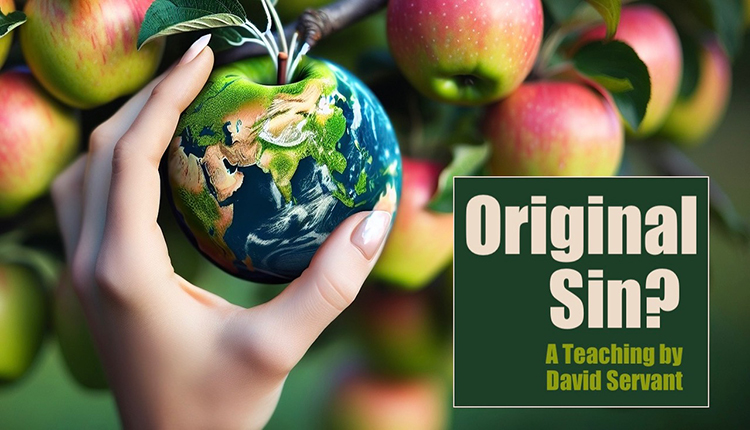
Original Sin?

By David Servant

You’ve probably heard the theological term, “original sin.” It is defined as “the innate tendency of all humans to sin, a condition inherited from Adam as a consequence of the Fall.” It is an attractive idea in one sense, because it allows us to put some of the blame for our sin on Adam.

The Parables of Life

By David Servant

It’s fun to think about the fact that Jesus created everything in the natural world that He used at a later time—during His earthly ministry—as teaching tools. That means it is possible, for example, that the primary reason He originally created the “birds of the air” and “lilies of the field” (Matt. 6:25-33) was to teach folks like me and you (who are paying attention) that God will take care of us.

Is the Phrase, “We are Saved by Grace Alone,” Biblical?

By David Servant

It is certainly wise to be suspicious of oft-repeated “Christian” doctrinal statements that utilize phrases that can’t be found anywhere in the Bible. Since the Bible consists of thousands of doctrinal phrases within its 783,000 words, it is certainly reasonable to think that all biblical doctrine could be expressed using actual phrases that are found somewhere within the Bible.

At the Heart of “Once-Saved-Always-Saved”

By David Servant

You may have heard that, some months back, California law regarding shoplifting was changed. Now, stealing merchandise worth $950 or less is just a misdemeanor rather than a felony. The result is that law enforcement generally doesn’t bother to investigate any shoplifting cases in which less than $950 in merchandise is stolen, and if there are charges, prosecutors dismiss them. As you might guess, shoplifting is on the rise in California.

Three Kinds of Death, and Their Remedy

by David Servant

Most Christians are familiar with Paul’s famous words in Romans 6:23: “The wages of sin is death.” They would seem to mean that disobedience to God earns the punishment of death. Although Paul’s declaration might explain why we all eventually die, it does raise some questions about the relationship between sin and death. For example, is physical death the only punishment for sin? If we have been forgiven of our sins, why do we still die? And once we are believers, can we sin without fear of death? I hope to answer those questions in this article. Let’s start by laying a foundation about the three kinds of death that are mentioned in Scripture.

The Spectrum of Grace

by David Servant

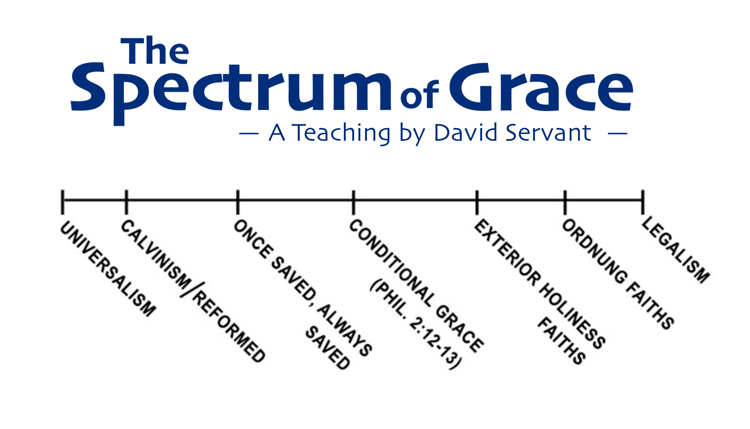
Did you know that the spectrum of theological belief within all of Christendom can be viewed as a spectrum of belief about grace? That spectrum ranges from Universalism to Legalism, and everything in between.

This teaching can help you identify where you are at on that spectrum, as well as evaluate if you should move from where you are. Some readers may discover that their spiritual journey can be traced on the spectrum, and for better or worse. If you are Calvinist/Reformed in your theological perspective, for example, you may never have realized how close you are on the spectrum of grace to Universalism. Similarly, if you are from an Amish background, your journey away from semi-legalism may actually have been a pendulum swing that has swung too far. My hope is that all readers will be helped to better understand Scripture’s perfect balance on this important issue.

I’m sure this teaching will elicit lots of feedback, and although I can promise that I will read it all, I may not be able to reply to it all. I appreciate everyone’s understanding in that. — David
Perhaps you’ve heard the story of the British woman whose neighbor commented on her garden, “My, what a lovely flower garden God has given you!” She replied, “I don’t mean to sound boastful, but you should have seen this flower garden when God had it all by Himself!”

That funny little story is actually an illustration of a big theological issue that challenges us all. We all know that God is working to accomplish His will, but we also know that human beings have a part to play in many outcomes both temporal and eternal. In the case of the British gardener, she knew that only God can turn a seed into a beautiful flowering plant. That being said, she also realized that, unless she strategically planted flower seeds, kept them watered, and periodically pulled weeds, the outcome would be an ugly mess. She knew what God was responsible for and what she was responsible for. In the end, both could rightfully take some credit for the outcome—although God’s contribution was certainly much more impressive than hers!

Christians often struggle trying to find the dividing line between divine and human responsibility. What is our job and what is God’s job? None of us wants to make a wrong assumption, but still, opinions vary. Although we are all reading from the same Bible, many theological debates revolve around this issue, and two words often surface within those debates. They are grace and works—two words that stand in contrast.

How do they differ?
How Gracious is Our Lord?

by David Servant

When you think about it, the phrase “gracious Lord” seems oxymoronic. A lord, by dictionary definition is: “Someone who has power, authority, or influence; a master or ruler, as in, lord of the sealords of the jungle, or our lord the king.” Masters and rulers exercise authority over their citizens or subjects. They expect and enforce compliance. They generally are not associated with grace. Rather, just the opposite.

How gracious is our Lord?

Yet at least 30 times in the New Testament epistles the words “grace” and “Lord” are found in the same verse. In 13 of those verses, the grace spoken of is directly attributed to either “the Lord Jesus,” “the Lord Jesus Christ,” “our Lord,” or “our Lord Jesus Christ.”

So, it is certainly safe to say that Jesus is a gracious Lord. Praise God for that. Let’s start by considering Christ’s lordship, and then we’ll consider His grace. We’re interested, not in a lopsided understanding, but a balanced one.

Grace Alone and Faith Alone: What is Wrong with the First Two Solas?

by David Servant

Perhaps you’ve heard a pastor or preacher say, “We are saved by grace alone, through faith alone, in Christ alone, as revealed by Scripture alone, to the glory of God alone.” Those are known as the “five solas” (or “solae”) because in Latin they are: Sola gratia, sola fida, solus Christus, sola scriptura, and soli Deo gloria. Although all five were not articulated together until the 20th century, the first two, grace alone and faith alone, were mentioned by some of the 16th-century Protestant Reformers to summarize what they felt was most wrong with Roman Catholicism. It isn’t easy, however, to summarize all that God has revealed about salvation in Scripture with four Latin words. In fact, it is impossible. That is one reason why God gave us an entire Bible, and not just four words.

"What's Wrong with the First Two Solas?" by David Servant

Anyone who reads the Bible and filters everything he reads through the first two solas is going to be scratching his head. That is always the problem with theological mantras. They are limited by their brevity, and if they’re unduly elevated, they can end up supplanting Scripture. If you find yourself often saying to yourself as you read the Bible, “That can’t mean what it says, because it doesn’t agree with one of the solas,” then you’ve got a problem. You are filtering the Bible through your theology rather than what you should be doing, and that is filtering your theology through the Bible.

But it can get even worse. Not only is Scripture often twisted to fit into theological mantras, but the mantras themselves are often twisted to mean what they did not originally mean. That has certainly happened regarding the first two solas. In the end, both Scripture and mantras are misused. Allow me to explain.